 |
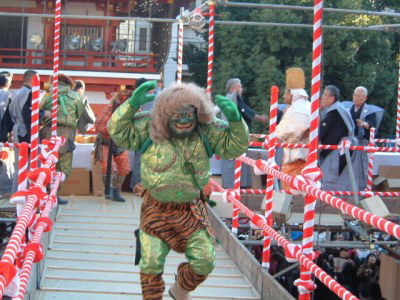 |
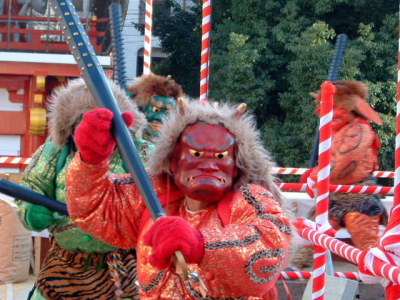
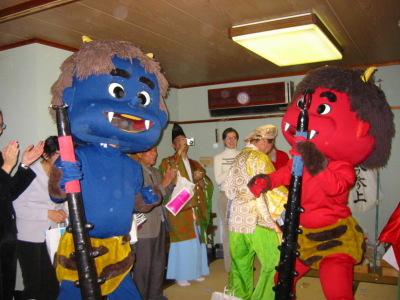
| "Oni" fight agains beans | At last, "Oni" give up and run away |
Setsubun
(Known as doing mame-maki / parched soybeans throwing)
One day before the first day of spring in the lunar calendar
(February 2 or 3)
2018's Eho: South-South-East ( Kasadera Kannon ) Date: February 3
|
|
| "Oni" fight agains beans | At last, "Oni" give up and run away |
Mamemaki (in Osu-Kannon)
Mamemaki (parched soybeans throwing ) takes place from 10:00 a.m. to 6:00
p.m..
Around 3 o'clock , a goblin parade will arrive at Osu-kannon
and perform a short story of Setsubun.
***
Arako-Kannon, Kasadera-Kannon, Jimokuji-Kannon and Ryusen-ji
These 4 temples are called "Owari-shi-Kannon/ Four representative
temples in the Owari region which enshrine Kannons"
(Kannon is a Goddess of Mercy.)
They are build on the direction of guards of Nagoya Castle, which settled
by Yin and Yang..
For the Setsubun Day of each year, they are roated as a luckey direction (恵方/eho) temple
**********
Originally Setsubun was the day before the first day of each season in the lunar calendar,
but today it more commonly refers to the day before Risshun* or the first day of spring.
In the present calendar it falls on February 3rd, 4th, or 5th.
Because of this, people stll write geishun ( welcome spring) etc. on new
years cards.
*In old days, there was a way of thinking that
formerly the new year starts on this day.
Setsubun has been celebrated in many ways, but Mame-maki,
scattering parched soybeans, is the most common custom throughout Japan.
On the evening of Setsubun, the head of the family or
toshi-otoko (men who were born in a year with same sign
of the Chinese zodiac as the current year/the Cock for the year 2005)
throw parched soybeans inside and outside the house
to summon good luck and drive away demons as they repeat the saying,
"Oni wa soto, Fuku wa uchi."
In a home, sometimes someone takes on the role of demon
and enjoys the ritual-like games such as running around to escape.
After the ritual of throwing parched soybeans, family members gather up
them
and eat a number of them equalling their age, because eating
these brings assurance of good health in the comming year.
.
| Traditional right way of bean throwing (mame-maki) at your home | ||||||||||||||||
 1: preparation |
2: Time of Mame-maki |
 3: How to throw |
4:Outside first |
|
 6: Eat soy beans |
|||||||||||
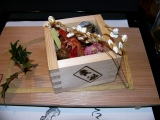
Put roasted soybeans in a measure which called "masu 升". If you have a household alter in you house, offer them to the gods till night, |
In the evening.(at night) Mame-maki should be held together with family |
In authentically, a man who was born in a year with the same sign of the Chinese zodiac as the current year or the head of family throw beans. Hold a "masu"on your chest and throw beans underhanded just like "The sower" by Jean-Francois Millet. This form means not only to drive out bad luck or oni but also to pray for agricultural fertility. Now father or elder man takes a role of Oni. |
First of all, throw them outside twice saying "Oni wa Soto"in order to prevent invasion by oni. As soon as you throw beans twice, get the door to shut properly. |
Next, throw beans in a house saying "Oni wa soto, Fuku wa uchi"as much as you want in order to keep good luck in a house and drive bad luck out. Start from the back room. And right after drive out evil shut the doors or windows. At the end, drive oni out from the entrance door. |
A bean is a symbol of good health. So, in order to get the power of beans, eat beans the same number of your age plus one. Extra one bean is for coming one year, to keep healthy life. |
|||||||||||
"The sower"
 |
In shrines and temples the Setsubun ritual is also held on a much bigger
scale.
Toshi-otoko and toshi-onna ( women of that year's zodiac sign) are invited to throw beans.
Movie stars, baseball players, kabuki players, sumo wrestlers and other
popular people are
also invited to the ritual in some temples or shrines.
This is because mamemaki is a very popular event throughout Japan.

<Hiiragi-Iwashi/柊鰯>
In some areas, people fix a branch of a holly, on which is stuck
a head of grilled sardine, to the door to drive out demon spirits.
The combination of the needle-like leaves of the holly branches
and the strong smell of the sardines helps in driving demon spirits away,
too.
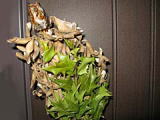 |
| Tokyo style Hiiragi-Iwashi |
Near Tokyo, people add a bean husk (mamegara/豆殻"because
it maks the sharp snapping sound in the fire which also drive out demon
spirits.

In some areas (especialy Kansei Area), it is customary to eat uncut rolled
sushi
facing the lucky direction called Eho in silence so that this year will bring them health and happiness.
Recently this custom becomes popular little by little because the nori
(sea laver) organizations
support it as a business opportunity.
These rolles are sold everywhere.

Oni wa soto !!! Fuku wa uchi !!!
| Year | The date of Setsubun |
Year | The date of Setsubun in February |
Year | The date of Setsubun February |
Year | The date of Setsubun February |
||||||
| date(Feb) | Lucky direction | temple | date(Feb) | Lucky direction | temple | ||||||||
| 2001 | 3 | SSE | Kasadera Kannon | 2026 | 3 | SSE | Kasadera Kannon | 2051 | 3 | 2076 | 3 | ||
| 2002 | 3 | NNW | Jimokuji Kannon | 2027 | 3 | NNW | Jimokuji Kannon | 2052 | 3 | 2077 | 2 | ||
| 2003 | 3 | SSE | Kasadera Kannon | 2028 | 3 | SSE | Kasadera Kannon | 2053 | 2 | 2078 | 2 | ||
| 2004 | 3 | ENE | Ryusenji Kannon | 2029 | 2 | ENE | Ryusenji Kannon | 2054 | 3 | 2079 | 3 | ||
| 2005 | 3 | WSW | Arako Kannon | 2030 | 3 | WSW | Arako Kannon | 2055 | 3 | 2080 | 3 | ||
| 2006 | 3 | SSE | Kasadera Kannon | 2031 | 3 | SSE | Kasadera Kannon | 2056 | 3 | 2081 | 2 | ||
| 0207 | 3 | NNW | Jimokuji Kannon | 2032 | 3 | NNW | Jimokuji Kannon | 2057 | 2 | 2082 | 2 | ||
| 2008 | 3 | SSE | Kasadera Kannon | 2033 | 2 | SSE | Kasadera Kannon | 2058 | 2 | 2083 | 3 | ||
| 2009 | 3 | ENE | Ryusenji Kannon | 2034 | 3 | ENE | Ryusenji Kannon | 2059 | 3 | 2084 | 3 | ||
| 2010 | 3 | WSW | Arako Kannon | 2035 | 3 | WSW | Arako Kannon | 2060 | 3 | 2085 | 2 | ||
| 2011 | 3 | SSE | Kasadera Kannon | 2036 | 3 | SSE | Kasadera Kannon | 2061 | 2 | 2086 | 2 | ||
| 2012 | 3 | NNW | Jimokuji Kannon | 2037 | 2 | NNW | Jimokuji Kannon | 2062 | 2 | 2087 | 3 | ||
| 2013 | 3 | SSE | Kasadera Kannon | 2038 | 3 | SSE | Kasadera Kannon | 2063 | 3 | 2088 | 3 | ||
| 2014 | 3 | ENE | Ryusenji Kannon | 2039 | 3 | ENE | Ryusenji Kannon | 2064 | 3 | 2089 | 2 | ||
| 2015 | 3 | WSW | Arako Kannon | 2040 | 3 | WSW | Arako Kannon | 2065 | 2 | 2090 | 2 | ||
| 2016 | 3 | SSE | Kasadera Kannon | 2041 | 2 | SSE | Kasadera Kannon | 2066 | 2 | 2091 | 2 | ||
| 2017 | 3 | NNW | Jimokuji Kannon | 2042 | 3 | NNW | Jimokuji Kannon | 2067 | 3 | 2092 | 3 | ||
| 2018 | 3 | SSE | Kasadera Kannon | 2043 | 3 | SSE | Kasadera Kannon | 2068 | 3 | 2093 | 2 | ||
| 2019 | 3 | ENE | Ryusenji Kannon | 2044 | 3 | ENE | Ryusenji Kannon | 2069 | 2 | 2094 | 2 | ||
| 2020 | 3 | WSW | Arako Kannon | 2045 | 2 | WSW | Arako Kannon | 2070 | 2 | 2095 | 2 | ||
| 2021 | 2 | SSE | Kasadera Kannon | 2046 | 3 | SSE | Kasadera Kannon | 2071 | 3 | 2096 | 3 | ||
| 2022 | 3 | NNW | Jimokuji Kannon | 2047 | 3 | NNW | Jimokuji Kannon | 2072 | 3 | 2097 | 2 | ||
| 2023 | 3 | SSE | Kasadera Kannon | 2048 | 3 | SSE | Kasadera Kannon | 2073 | 2 | 2098 | 2 | ||
| 2024 | 3 | ENE | Ryusenji Kannon | 2049 | 2 | ENE | Ryusenji Kannon | 2074 | 2 | 2099 | 2 | ||
| 2025 | 2 | WSW | Arako Kannon | 2050 | 3 | WSW | Arako Kannon | 2075 | 3 | 2100 | 3 | ||
**********
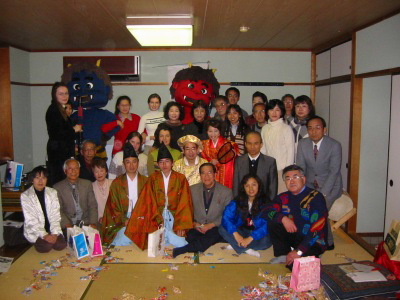
Cute Oni delivery service
 |
 |